What the fibre label on a DRSKIN base layer is telling you
Ninety-two per cent polyester and eight per cent spandex is on almost every label here, and the small number is the one that matters. What the labelling rule requires a maker to print, what a care label is legally promising, and what a UPF number does and does not cover.

Turn a pair of compression tights inside out and the label says something like 92% polyester, 8% spandex. Almost every garment on this site says the same thing, which makes it look like boilerplate. It is not: that label is a legal document with a rule number behind every line of it, and the small number on it is the one that decides how the garment behaves.
Why the eight per cent is named at all
Under the federal textile labelling rules, a garment sold in the United States has to state its fibre content by generic name and by percentage of weight, listed in descending order, plus the country where it was processed and who made or marketed it. So far, so dull.
The interesting part is the exception. A fibre that makes up less than five per cent of the weight can be swept into "other fiber" — unless it has, in the rule's own words, definite functional significance, in which case it gets named. The example the rule itself gives is spandex, named for elasticity. So a label reads 92 and 8 rather than 92 and "other fiber", and it is a small piece of evidence that the eight per cent is doing a job rather than riding along.
What that job is, physically: polyester holds a shape and moves water along a fibre, but it does not recover well when you pull it. Spandex does almost nothing except recover. Eight per cent of it through a knit is what pulls a leg back to its own dimensions after it has been dragged over a heel, sat in for an hour and washed forty times. Take it out and you have a garment that fits beautifully once.
What the same knit does with a different finish
Three of the four fabrics on this site are the same fibre content finished differently, and the card names the finish rather than making you guess from a photograph.
| What the card says | What has been done to the knit | Where it turns up |
|---|---|---|
| 92% polyester, 8% spandex | Nothing; the plain compression knit, smooth both sides | Tights, compression shorts, long and short sleeves |
| Fleece-lined | The inside face brushed so it holds still air; outside left smooth | The winter tights, the fleece top, the turtleneck |
| Mesh panels | A more open knit structure in the same fibre | The muscle tanks and the sleeveless base layers |
| Quick-dry | A finish on the same polyester that speeds evaporation | Most of the training tees and several tight packs |
Where a piece gives no fibre content in our product data, the line on the card is left blank rather than filled in from a neighbour. A blank there means we do not have the number, not that the garment has no label.
The care label is a promise with evidence behind it
The other label sewn into the seam is governed by the Care Labeling Rule, and it has a shape. A washing instruction must say whether the garment goes in a machine or a sink, and give a water temperature if hot water would harm it. It must mention bleach only where a bleach would cause damage. It must give a drying method, and a temperature where heat would harm. It must give ironing instructions where ironing is regularly needed. And it must warn against any procedure a buyer might reasonably assume was safe.
Two things in that rule are worth a customer knowing. First, the maker has to hold reliable evidence for each instruction — it is not a wish list. Second, the label has to stay attached and legible for the useful life of the garment, which is why cutting the itchy one out is a decision rather than a housekeeping task.
On a polyester and spandex knit the practical version is short: cold water, no fabric softener, and out of the tumble dryer if you can manage it. Heat is the one thing that ages spandex quickly, and a base layer that has lost its recovery is a base layer that bags at the knee. The label sewn into your particular garment is the one that governs; ours is a summary of what those labels generally say.
What a UPF number covers, and what it does not
Most of the short-sleeve training tees on this site carry a UPF rating, and it is the only number here that is a claim about a body rather than about a garment. It deserves to be read exactly.
UPF says how much ultraviolet, UVB and UVA both, a fabric lets reach the skin underneath it. UPF 50 blocks 98 per cent and lets two per cent — a fiftieth — through; 50 is the lowest rating the Skin Cancer Foundation puts its seal on. The number describes dry, unstretched cloth. Stretched or wet, a fabric loses some of that protection and turns more transparent, and the Foundation's own illustration is a white T-shirt that rates about UPF 7 dry and about 3 wet.
And it only covers what it covers. On a short-sleeve tee that is the torso and the top of the arm, and nothing else. The American Academy of Dermatology asks for a broad-spectrum, water-resistant sunscreen of SPF 30 or higher on every bit of skin the clothing does not cover, even under protective clothing, and prefers dark colours and dense weaves to pale, open ones. A tee with a number on it is one part of the answer rather than the whole of it.
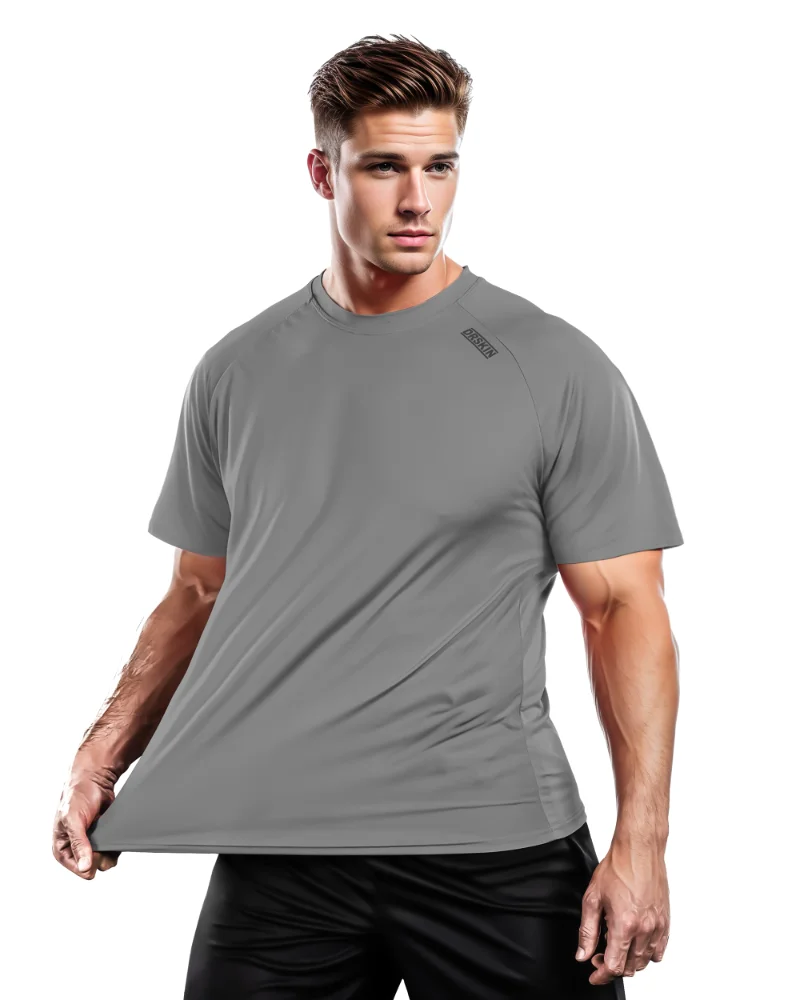
DRSKIN Sun-Protection Training Tee
The quick-dry training tee: a wicking knit, cut loose rather than close, in five colourways.
$14.99
What we will not read into a label
A fibre content is a fact and we will print it. What it is not is evidence for the sentences that usually get written next to it: that a fabric supports a muscle, speeds a recovery, prevents an injury or improves a performance. None of those are on this site, and no percentage on a label would justify them.
The same goes the other way. A label that says 92 and 8 does not tell you the knit is dense, the seams are flat or the waistband is wide, because none of those are fibre content. They are construction, they are on the card as separate lines, and they are what actually differs between a nine-dollar pair of tights and a sixty-dollar one.
More of this sort of thing is in Field Notes, and the DRSKIN pattern room keeps the whole range one click away on the front page.